
7 Mistakes Small Businesses Make in Digital Marketing (And Exactly How to Fix Them)
We’ve seen the mistakes in digital marketing cost businesses real money, real time, and real growth. The frustrating part? Every single one of them is avoidable — once you know what to look for.
The 7 Mistakes We Cover
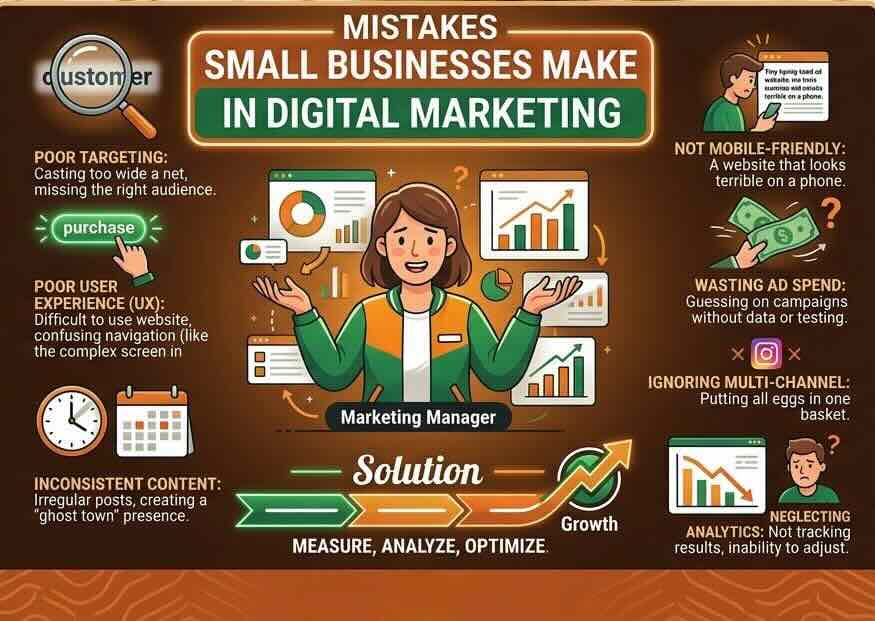
- Trying to be everywhere at once
- No clear goal — just “more visibility”
- Ignoring SEO completely
- Posting without a strategy
- Sending traffic to a broken website
- Not tracking anything
- Giving up too soon
Let’s start with a story to understand mistakes made in digital marketing. A few months ago, we got a call from a small business owner in Haryana — a modest tutoring centre that had been around for years and was doing decent work. But their enquiries were drying up, walk-ins had slowed down, and a newer competitor nearby was visibly growing.
They had tried digital marketing. They’d run some Facebook ads, posted on Instagram for a while, even paid someone to “do SEO.” But nothing seemed to work. They were frustrated, a little sceptical, and — honestly — close to writing off digital marketing entirely.
Within a few weeks of working with them, we identified the real issue. It wasn’t that digital marketing didn’t work for their business. It was that they had been making several very common, very fixable mistakes — the same ones we see across dozens of small businesses every year.
This blog is about those mistakes. Not to shame anyone — these are genuinely easy traps to fall into, especially when you’re running a business and marketing is just one of twenty things on your plate. But awareness is the first step to getting it right.
82%
of small businesses say they struggle with consistent digital marketing
60%
have no documented digital marketing strategy
3x
more leads generated by businesses that blog consistently vs those that don’t
70%
of consumers check a business online before visiting or buying
01 Trying to Be on Every Platform at Once
This is probably the most common mistake we see — and it comes from a good place. You hear that you need to be on Instagram, Facebook, LinkedIn, YouTube, Twitter, WhatsApp, and maybe even Pinterest. So you set up accounts everywhere, try to post on all of them, get overwhelmed within a month, and quietly abandon most of them. Now you have six half-dead social media accounts and nothing to show for it.
Here’s the truth: a strong presence on two platforms beats a weak presence on six — every single time. And not every platform is right for every business. A B2B chartered accountancy firm has no business spending hours on Instagram Reels. A local bridal wear boutique probably doesn’t need to be on LinkedIn.
The right question isn’t “which platforms exist?” — it’s “where does my specific customer actually spend time online?” Answer that first, then go deep on those platforms before you consider expanding anywhere else.
❌ What most businesses do
Create accounts everywhere, post inconsistently, burn out, and go silent on all channels.
✅ What actually works
Pick 1–2 platforms where your audience lives. Show up consistently, build real engagement, then expand.
02 Having No Clear Goal — Just “More Visibility”
“We just want more visibility.” We hear this constantly. And while visibility sounds like a reasonable goal, it’s actually not a goal at all — it’s a vague wish. And vague wishes produce vague results.
Imagine telling a contractor: “I want a better house.” They’ll ask you — better how? More rooms? A new kitchen? A terrace? Different localities, different budgets, different timelines. Marketing works the same way. Without a specific goal, you can’t build a specific strategy. And without a specific strategy, you end up spending money on things that look busy but don’t move your business forward.
Before you spend a single rupee on digital marketing, get clear on what success looks like for your business. Is it 50 new enquiries per month? 200 website visitors per week? 500 new Instagram followers who match your target customer profile? A 30% increase in online orders? These are real goals. “More visibility” is not.
❌ Vague goal
“We want more visibility and brand awareness online.”
✅ Clear goal
“We want 80 qualified leads per month from Google within 6 months, with a cost per lead under ₹300.”
03 Ignoring SEO — or Treating It as a One-Time Task
We’ve met business owners who paid someone ₹5,000 to “do SEO” on their website once — three years ago — and genuinely believe their SEO is sorted. It isn’t. SEO is not a one-time fix. It’s an ongoing process of making your website the most credible, relevant, useful source of information for the things your customers are searching for.
And here’s what makes ignoring SEO so costly: when someone in your city searches for the product or service you offer, they’re not a cold lead. They’re actively looking for a solution. If your website doesn’t appear, your competitor’s does — and they get the business. Every single day you’re not ranking, you’re handing leads to someone else.
Small businesses often skip SEO because it feels slow and invisible compared to running ads. And it is slower — but it’s also cumulative. A well-optimised blog post can drive enquiries for years. A Google ad stops the moment you stop paying. Both have their place, but ignoring SEO entirely is one of the costliest long-term mistakes a business can make.
❌ The mistake
Ignoring SEO, relying only on paid ads, or treating SEO as a one-time checkbox exercise.
✅ The fix
Start with local SEO — optimise your Google Business Profile, build location-specific pages, and publish consistent helpful content every month.
Quick win: If you haven’t claimed and fully filled out your Google Business Profile yet — do it today. It’s free, takes 30 minutes, and can start bringing in local search traffic almost immediately.
04 Posting Content Without Any Real Strategy
You know that feeling when you haven’t posted on Instagram in two weeks, so you quickly take a photo of your office or share a “Good Morning” graphic just to stay active? Yeah. That’s not a content strategy — that’s content anxiety. And it’s doing more harm than good.
Random posting creates a random impression. If someone visits your Instagram page and sees a jumble of product photos, motivational quotes, festival greetings, and the occasional half-hearted Reel — they don’t understand who you are, what you stand for, or why they should follow you. And they don’t. They leave.
A real content strategy starts with three questions: Who am I talking to? What do I want them to feel, think, or do? And what kind of content will actually serve them? Your content should educate, entertain, or inspire your specific audience — not just fill a calendar. Quality and intentionality will always beat volume and randomness.
❌ Random posting
Festival graphics, random motivational quotes, inconsistent product posts — no thread connecting any of it.
✅ Strategic content
A content calendar with defined content pillars — education, storytelling, social proof, offers — each serving a specific stage of the customer journey.
Content pillars to consider for most small businesses: Educational tips in your niche · Behind-the-scenes of your work · Customer stories and testimonials · Busting common myths in your industry · Offers and product highlights (sparingly — max 20% of content)
“The businesses that win on social media aren’t the ones posting the most. They’re the ones posting with the most clarity about who they’re talking to and why.”
05 Driving Traffic to a Website That Doesn’t Convert
This one is painful to watch. A business invests in Google Ads or SEO, starts getting traffic to their website — and then nothing happens. No enquiries, no calls, no form fills. They assume digital marketing doesn’t work and pull the plug. But the real problem? The website itself.
Think of your website as a shop. You’ve paid to bring people to the door — but if the shop is cluttered, confusing, slow to open, or doesn’t clearly show what you sell — customers walk right back out. All that traffic goes to waste.
A converting website isn’t necessarily a fancy or expensive one. It just needs to answer four questions the moment someone arrives: Who are you? What do you offer? Why should I trust you? And what do you want me to do next? If those answers aren’t crystal clear within five seconds, you’re losing potential customers every day.
❌ Common website mistakes
Slow loading speed · No clear call-to-action · Not mobile-friendly · Outdated design · No testimonials or trust signals
✅ Non-negotiable basics
Loads in under 3 seconds · Clear headline on homepage · Prominent contact button · Mobile-optimised · At least 3–5 genuine reviews or testimonials visible
Check your website’s speed right now at PageSpeed Insights (free tool by Google). A score below 50 on mobile is costing you customers and rankings.
06 Not Tracking Anything — Flying Completely Blind
Here’s a question: do you know which of your marketing activities is actually bringing in customers right now? If the answer is “not really” or “I think it’s Instagram,” you’re flying blind. And flying blind means you can’t improve, can’t invest smartly, and can’t tell what’s worth continuing.
We’ve spoken to business owners spending ₹20,000 a month on ads with no idea what that money is producing. No tracking, no reporting, no way to know if those ads are bringing in ₹5,000 or ₹2,00,000 in business. That’s not marketing — that’s hoping.
You don’t need a data science degree to fix this. Start simple: set up Google Analytics on your website, connect your Google Business Profile to track calls and direction requests, and check your ad reports monthly. Just knowing where your enquiries are coming from will immediately sharpen how you spend your time and budget.
❌ Flying blind
Running campaigns with no tracking setup, no conversion goals defined, and no way to measure what’s working.
✅ Start tracking
Google Analytics 4 + Google Search Console + Monthly ad reports. Even basic tracking will transform how you make marketing decisions.
The three numbers every small business should know: Cost per lead (what you spend to get one enquiry) · Lead-to-customer conversion rate · Which channel brings your highest-quality leads. Know these three, and you’ll always know where to invest more.
07 Giving Up Too Soon — Before Anything Has Time to Work
This might be the most heartbreaking mistake of all — because it happens after someone has done everything else right. They’ve picked the right platforms, set clear goals, hired someone good, started producing content. And then at month two or three, when the results aren’t dramatic yet, they pull back. They “pause” the budget, switch agencies and conclude that digital marketing “just doesn’t work” for their type of business.
Digital marketing is not a light switch. It’s a flywheel. The first few months, you’re building foundations — optimising your website, understanding your audience, finding the content that resonates, warming up the algorithm, earning your first Google rankings. It feels slow. It can be frustrating. But this foundational work is what makes everything that comes after accelerate.
Most businesses that we’ve seen get real, sustainable digital marketing results started seeing meaningful traction between months four and six. The ones that gave up at month two never found out how close they were.
❌ The impatience trap
Expecting leads in week two, switching strategies monthly, and concluding “digital marketing doesn’t work” before it’s had a real chance.
✅ The right mindset
Commit to a 6-month runway. Measure progress by leading indicators (traffic, engagement, rankings) before expecting lagging ones (revenue, leads).
A Quick Self-Audit — How Many Apply to You?
Be honest with yourself. Go through this checklist and count how many currently describe your business:
Are you making these mistakes?
- →Maintaining accounts on 4+ social platforms without consistent activity on any
- →Can’t state your specific monthly digital marketing goal in one sentence
- →Haven’t published new content (blog, video, social) in over 3 weeks
- →Your Google Business Profile is incomplete or unverified
- →Your website takes more than 4 seconds to load on mobile
- →You don’t know how many leads came from digital last month — or where they came from
- →You’ve changed your digital marketing approach more than twice in the last 6 months
If you ticked three or more — don’t worry. You’re in good company, and every one of these is fixable. The fact that you recognise them is already further than most businesses get.
Quick Summary — Mistake vs. Fix
| Mistake | The Fix |
| Being everywhere at once | Go deep on 1–2 platforms where your audience actually is |
| No clear goal | Set a specific, measurable monthly target before spending anything |
| Ignoring SEO | Start with your Google Business Profile and local keyword content |
| Random posting | Build a simple content calendar with defined pillars and purpose |
| Poor website | Fix speed, mobile design, clarity, and add trust signals |
| No tracking | Set up GA4, Search Console, and review your numbers monthly |
| Giving up too soon | Commit to a 6-month plan and measure leading indicators first |
Final Thoughts — From the Digi Modway Team
Running a small business is genuinely hard. Marketing is just one of a hundred things competing for your attention every day. So when digital marketing doesn’t immediately deliver results, it’s completely understandable to feel let down — or to assume it’s not for you.
But here’s what ten years of working with businesses across industries has taught us: digital marketing almost always works when it’s done with clarity, consistency, and patience. The businesses that struggle aren’t struggling because digital marketing fails them — they’re struggling because one or more of these seven mistakes is quietly draining the impact of everything they’re doing.
Fix the foundations. Get clear on the goal. Show up consistently in the right places. And give it time. That combination, done well, has transformed businesses we’ve worked with from stagnant to growing — not through miracles, but through steady, intelligent effort.
“The difference between businesses that win at digital marketing and those that don’t usually isn’t budget or luck — it’s clarity, consistency, and the courage to stay the course.”
If you went through this list and recognised your own business in some of these mistakes — that’s actually a good thing. It means the solutions are right in front of you. And if you want a hand identifying exactly where to start, we’re always happy to have that conversation.
Not sure which of these mistakes are holding your business back the most?
Get a free digital audit from the Digi Modway team — we’ll tell you exactly where to focus first.
~ Digi Modway Editorial Team
Helping Indian small businesses grow smarter, spend better, and market with confidence.