

The Psychology Behind Online Buying Decisions — Why People Buy What They Buy
Every time someone buys something online, they believe it was a rational decision. In reality, their brain had already made up its mind — and logic just came along for the ride. Understanding this is the single biggest competitive advantage you can have as a marketer or business owner.
What We Cover
- The real reason people buy online (it’s not what you think)
- The online buyer’s journey — through a psychological lens
- 8 powerful psychological triggers that drive purchases
- How emotions quietly run the show
- The trust equation — what makes people finally click “buy”
- How to apply all of this to your marketing right now
Picture this. It’s 11 pm. Someone is lying in bed, phone in hand. They weren’t planning to shop. But they saw a Reel of someone unboxing a product, clicked on the link, read three reviews, and — almost without realising it — placed an order. By the time they put the phone down, they’re already wondering when it’ll arrive.
Sound familiar? You’ve probably done this yourself. And if you’re running a business, you need to understand exactly what happened in that person’s brain between the Reel and the order confirmation. Because that — right there — is where digital marketing either wins or loses.
At Digi Modway, we believe the best marketing isn’t the loudest or the most expensive. It’s the kind that genuinely understands people — what they fear, what they want, what makes them trust you, and what makes them hesitate. Consumer psychology is the foundation of all of that. Let’s get into it.
95%
of purchase decisions are made subconsciously, driven by emotion
7 sec
Average time before a visitor forms a first impression of your website
88%
of consumers trust online reviews as much as personal recommendations
3x
more likely to purchase when social proof is prominently displayed
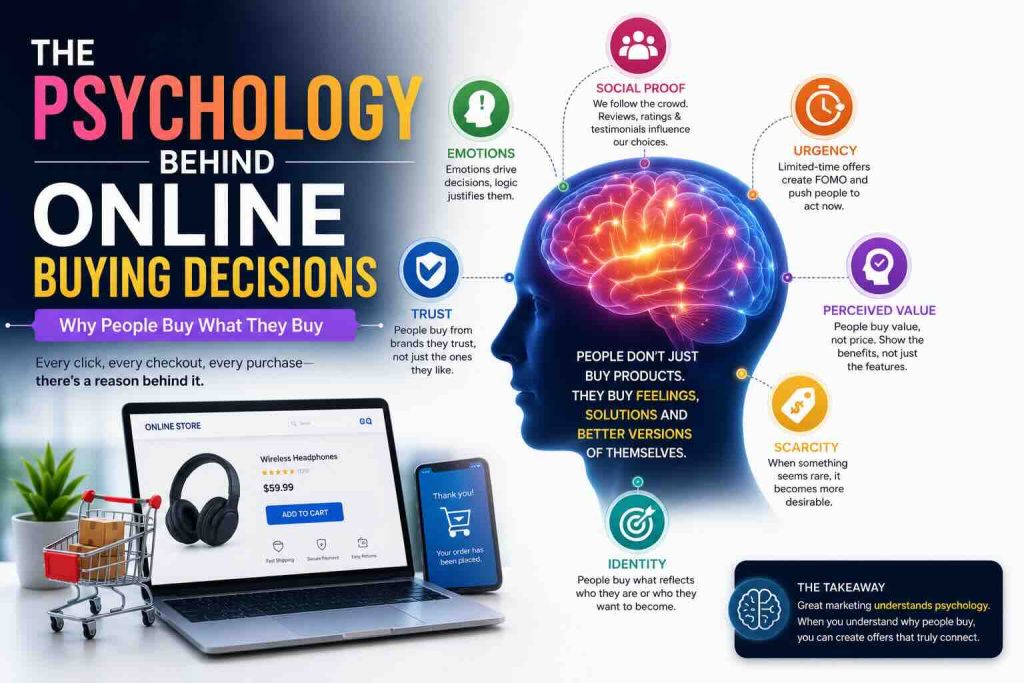
The Real Reason People Buy Online — It’s Rarely About the Product
Here’s something that took marketers decades to fully accept: people don’t buy products. They buy feelings, identities, solutions to fear, and shortcuts to a better version of themselves.
Someone buying a premium skincare product isn’t really buying moisturiser. They’re buying the feeling of self-care, the hope of confidence, the identity of someone who takes care of themselves. Someone buying a digital marketing course isn’t buying video lessons. They’re buying the vision of a better income, career security, and being ahead of the curve.
The product is just the vehicle. The emotional destination is what sells.
This isn’t manipulation — it’s empathy at scale. The best marketers in the world are simply the ones who understand their customers deeply enough to speak to what they actually want, rather than just listing what they’re selling.
“People don’t buy what you do. They buy why you do it — and more importantly, how it makes them feel about themselves.”
The Online Buyer’s Journey — Through a Psychological Lens
Before we dive into the specific triggers, it helps to understand that a buyer’s mind goes through a predictable journey — and your marketing needs to meet them at every stage of it.
💡 Awareness — “I didn’t even know I needed this”
A scroll, a search, a friend’s recommendation. At this stage, the buyer isn’t actively looking — they’re just becoming aware that a problem or desire exists. Your content, ads, and social presence need to spark recognition: “Yes, that’s exactly what I’ve been feeling.”
🔍 Consideration — “Let me look into this more”
Now they’re actively researching. Reading reviews, watching videos, comparing options, visiting your website. At this stage, trust and clarity are everything. Confusion = exit. Reassurance = progress.
⚖️ Decision — “Okay, but should I buy from THIS brand?”
They’ve decided they want the product. Now they’re deciding on the seller. Social proof, pricing psychology, risk reduction (easy returns, guarantees) — these are what tip the scales here.
✅ Purchase — “Add to cart”
The moment of commitment. Friction here is fatal — complicated checkouts, hidden charges, slow loading, lack of payment options. Every extra step loses buyers.
💬 Post-Purchase — “Did I make the right choice?”
Buyer’s remorse is real. How you communicate after the sale — confirmation emails, delivery updates, follow-up messages — shapes whether this person buys again and tells their friends.
8 Psychological Triggers That Drive Online Buying Decisions
Now let’s get into the fascinating part — the invisible psychological forces that push people from “maybe” to “yes.” These aren’t tricks or manipulation tactics. They’re deeply human tendencies that have been part of how we make decisions long before the internet existed. Understanding them helps you market honestly and effectively.
⏳ Trigger 01
Scarcity & Urgency — The Fear of Missing Out
Our brains are hardwired to want things more when they seem limited or about to disappear. This isn’t a marketing invention — it’s survival psychology. When resources were scarce in our evolutionary past, hesitation meant losing out. That instinct is still alive and well when we see “Only 3 left in stock” or “Offer ends tonight.”
Scarcity works because it creates a mental shift: the decision is no longer “should I buy this?” but “can I afford NOT to buy this right now?” That reframe is enormously powerful. Research consistently shows that people are more motivated by the fear of loss than by the prospect of an equivalent gain.
But — and this is important — fake scarcity destroys trust the moment people notice it. If the “only 2 left” counter resets every day, customers figure it out. Real urgency (genuine sale deadlines, actual stock limits, real seasonal offers) works. Manufactured urgency backfires.
✦ Apply This to Your Marketing
Use genuine limited-time offers with real deadlines. Show actual stock counts on product pages. Create seasonal campaigns with authentic end dates. Make the consequence of waiting clear — not as a threat, but as honest information.
👥 Trigger 02
Social Proof — “If Others Trust It, Maybe I Should Too”
Humans are deeply social creatures. When we’re uncertain about a decision, we instinctively look at what others around us are doing. Online, this manifests as reviews, ratings, testimonials, user-generated content, influencer recommendations, and even simple metrics like “10,000 customers served.”
Social proof is particularly powerful in India, where word-of-mouth has always been the dominant form of trust-building. An Indian consumer is far more likely to trust a detailed review from someone with a similar background than a polished brand advertisement. In fact, studies show that 88% of consumers trust online reviews as much as personal recommendations from friends.
What makes social proof especially interesting is that it works even when we know we’re being influenced by it. We know the restaurant with a queue outside is probably good. We know 4.8 stars means something. The logic is sound — other people’s collective experience really is useful information.
✦ Apply This to Your Marketing
Collect reviews actively and display them prominently — on your homepage, your Google profile, your product pages, and your ads. Video testimonials are 10x more persuasive than text. Show real customer photos, share user-generated content, and don’t hide negative reviews — thoughtful responses to them actually increase trust.
🎁 Trigger 03
Reciprocity — The Urge to Give Back
There’s a deeply human discomfort that comes from receiving something without giving anything back. Psychologists call it the reciprocity principle, and it’s one of the most consistently powerful forces in human behaviour. When someone gives us something — genuinely, without immediate expectation — we feel an almost instinctive desire to return the favour.
In digital marketing, this plays out through free value. A business that teaches you something useful, gives you a free tool, or solves a small problem before asking for anything has subtly shifted the relationship. You don’t feel like you’re being sold to. You feel like you’re dealing with someone who genuinely wants to help you. And that makes saying yes to their eventual offer feel natural — even good.
This is exactly why content marketing is so powerful. Every helpful blog post, every free guide, every useful video is not just a traffic strategy — it’s a psychological deposit in the trust bank of everyone who consumes it.
✦ Apply This to Your Marketing
Give before you ask. Publish genuinely useful content. Offer free consultations, downloadable guides, or trial periods. The more real value you provide upfront — without a catch — the more goodwill you build, and the warmer your eventual conversion will be.
⚓ Trigger 04
Anchoring — The First Number Wins
Here’s a simple question: is ₹2,999 cheap or expensive? The answer completely depends on what number you saw first. If you saw ₹5,999 crossed out before seeing ₹2,999, it feels like a steal. If ₹2,999 is the first number you encounter with no context, it might feel steep. Same price. Completely different perception. That’s anchoring.
The anchor — the first piece of numerical information we encounter — disproportionately influences every judgement we make after it. Our brains are not calculating absolute value; they’re calculating relative value. This is why showing a “original price” alongside a discounted price is so effective. It’s also why premium pricing tiers on a pricing page make mid-tier options look reasonable by comparison.
Anchoring is everywhere once you notice it. The ₹199 item that seems irresistible next to a ₹599 item. The “most popular” plan sitting between a cheap and expensive option. The agency package that makes the smaller package feel like great value. All anchoring, all psychology.
✦ Apply This to Your Marketing
Always show original prices alongside discounted ones. On pricing pages, include a premium tier even if most customers won’t buy it — it makes your mid-range look attractive. Lead with the most impressive metric or value first in your messaging.
🪞 Trigger 05
Identity & Self-Image — “This Says Something About Who I Am”
People don’t just buy products — they buy extensions of their identity. What we own, wear, use, and consume sends signals to the world (and to ourselves) about who we are, what we value, and where we belong. This is not vanity — it’s a fundamental human need for self-expression and belonging.
Think about brand loyalty. Why do some people only drink one specific brand of coffee, drive a particular car brand, or always shop at a specific store? Rationally, there are often cheaper or equally good alternatives. But changing brands would feel like a small betrayal of who they are. The brand has become part of their identity.
In the Indian context, this is especially visible. The choice between brands often carries implicit signals about aspiration, success, modernity, tradition, or community membership. A first-generation entrepreneur buying a business book isn’t just buying information — they’re buying into the identity of someone who invests in themselves. Understanding this transforms how you write your copy, design your visuals, and position your brand.
✦ Apply This to Your Marketing
Ask yourself: what does buying your product say about a person? Then make that identity explicit and aspirational in your messaging. “For people who take their health seriously.” “For the business owner who doesn’t settle for average.” Speak to who they want to be, not just what they want to buy.
😰 Trigger 06
Loss Aversion — Losses Hurt More Than Gains Feel Good
Nobel Prize-winning psychologists Daniel Kahneman and Amos Tversky discovered something counterintuitive: losing ₹500 feels roughly twice as bad as gaining ₹500 feels good. We are not rational calculators of value — we are deeply loss-averse creatures. This asymmetry shapes almost every decision we make, including online purchases.
This is why “Don’t miss out” outperforms “Get this deal.” Why “Stop losing customers to competitors” hits harder than “Gain more customers.” Why free trials work so well — once you have something, the idea of losing access to it is more motivating than the prospect of gaining it was in the first place.
Great marketers frame their offers in terms of what the customer stands to lose by not acting — not as a scare tactic, but as a genuine mirror of reality. If your service genuinely prevents a problem or closes a gap, saying so clearly is both honest and psychologically resonant.
✦ Apply This to Your Marketing
Reframe some of your messaging from gain-focused to loss-focused. “Join 5,000 businesses growing with us” is good. “Don’t let your competitors get further ahead while you wait” is often more compelling. Use free trials to trigger ownership psychology. Offer money-back guarantees to neutralise the fear of loss.
🏆 Trigger 07
Authority — We Trust Experts, Even Online
When a doctor recommends something, we’re more likely to follow their advice than if a friend says the same thing. When a brand is featured in a well-known publication, we view it as more credible. This is the authority principle — our tendency to trust and follow people or entities that demonstrate expertise, credentials, or leadership in their field.
Online, authority signals are everywhere: certifications and awards, press coverage, years of experience, detailed case studies, thought leadership content, the quality of your own writing and communication, and even how your website looks and feels. A poorly designed website with generic content signals low authority. A clean, professional website with original expert content signals the opposite.
For small and medium businesses in India, building perceived authority is one of the highest-leverage things you can do. You don’t need a national award or a Times of India feature to be seen as an authority in your local market or niche — you just need to consistently demonstrate that you know your stuff.
✦ Apply This to Your Marketing
Create content that demonstrates deep expertise — detailed guides, original insights, industry commentary. Display any certifications, awards, or media mentions prominently. Let real results speak for you through detailed case studies. The more you teach, the more authority you earn.
🤝 Trigger 08
The Mere Exposure Effect — Familiarity Breeds Purchase
Here’s a fascinating one. Research shows that we tend to develop a preference for things simply because we’ve been exposed to them more often — even if we don’t consciously remember seeing them. This is called the mere exposure effect, and it explains something every marketer has noticed: people buy from brands they recognise.
This is why consistent brand presence matters so much, even when it doesn’t seem to be generating immediate results. The person who sees your Instagram posts for three months, reads two of your blog articles, and gets retargeted by your ad once — they’re far more likely to trust you than someone encountering your brand cold. You feel familiar. And familiarity, in the absence of a bad experience, feels like safety.
In a noisy digital world, the brands that show up consistently — even in small ways — are quietly building preference every day. This is the compounding interest of brand marketing, and it’s why abandoning your digital presence after a few months of “no visible results” is such a costly mistake.
✦ Apply This to Your Marketing
Show up consistently, even when engagement feels low. Use retargeting ads to stay in front of people who’ve visited your website. Maintain a regular content schedule. The goal isn’t just to be seen once — it’s to become the brand that feels familiar when someone is finally ready to buy.
How Emotions Quietly Run the Entire Show
We’ve talked about specific triggers, but let’s zoom out for a moment. Underneath all of them is one unifying truth: emotion drives buying decisions, and logic justifies them after the fact.
Neuroscientist Antonio Damasio famously studied patients who had damaged the emotional centres of their brains while keeping their rational faculties intact. You’d expect these people to make incredibly rational decisions. Instead, they became paralysed by even the simplest choices — what to eat, what to wear, which appointment to schedule first. Without emotion to provide a felt sense of preference, decision-making collapsed entirely.
What this means for marketing is profound. If you’re writing copy that only appeals to logic — features, specifications, technical advantages — you’re talking to a part of the brain that doesn’t actually make purchase decisions. You need to make people feel something first. Curiosity. Excitement. Relief. Safety. Aspiration. The logical justification (value for money, quality, reliability) comes second — but it still needs to be there, because that’s how people explain their decision to themselves and others.
Emotions That Drive Online Purchases
😰Fear of missing out
🌟Aspiration & desire
😌Relief from a problem
🤗Belonging & community
🔒Safety & reassurance
😄Joy & delight
💪Pride in identity
🎯Confidence in the right choice
The Trust Equation — What Makes People Finally Click “Buy”
All the psychological triggers in the world won’t convert a visitor who doesn’t trust you. Trust is the prerequisite for every sale. And online, where people can’t physically touch your product, meet you in person, or verify your claims on the spot, trust is built through an accumulation of small signals.
🔐 Trust Builders
Clear contact details · Genuine customer reviews · Professional, fast-loading website · Transparent pricing · Secure payment badges · Real team photos · Consistent brand voice · Prompt responses to queries
⚠️ Trust Destroyers
Spelling errors and sloppy design · Hidden charges at checkout · Stock photos instead of real images · No reviews or only 5-star reviews · Slow website · Unanswered comments or messages · Vague refund policies · Inconsistent social media presence
Notice that trust is easier to destroy than to build. One bad review that’s ignored, one surprise charge at checkout, one week of no response to DMs — these things undo months of positive impression-building. Which is why customer experience and marketing are inseparable. You can’t consistently market your way past a consistently poor experience.
How to Apply All of This to Your Marketing — Practically
This is a lot of psychology. Let’s bring it back to earth with what you can actually do differently starting this week:
Your Psychology-Informed Marketing Checklist
- ◆Audit your homepage — does it speak to an emotional outcome, or just list features and services?
- ◆Are your customer reviews displayed prominently — not buried on a separate “Testimonials” page?
- ◆Do your calls-to-action reduce fear? (“Try free for 14 days” vs. “Buy now”)
- ◆Are you using genuine scarcity — real deadlines, real stock limits — rather than fake urgency?
- ◆Does your content give genuine value before asking for anything in return?
- ◆Is your pricing page anchored with a premium option to make your target offer feel like good value?
- ◆Does your brand speak to a specific identity — who does your customer want to be?
- ◆Are you showing up consistently enough for the mere exposure effect to work in your favour?
Final Thoughts — Marketing That Respects the Human Mind
Here’s the thing about psychology in marketing: it only works sustainably when it’s honest.
You can use scarcity to nudge someone toward a purchase — but if the product disappoints, they won’t come back. One may use social proof to build trust — but if the reviews are fake, the trust is borrowed and will collapse. You can speak to someone’s identity — but if your brand doesn’t actually deliver on that promise, the relationship ends there.
The most successful brands aren’t the ones that manipulate people into buying. They’re the ones that understand their customers so well that their marketing feels like a conversation between friends — one who genuinely has what the other genuinely needs.
At Digi Modway, everything we do is rooted in this understanding. When we build campaigns, write content, design ads, or plan strategies for our clients, we’re not just thinking about clicks and conversions. We’re thinking about the person on the other side of the screen — what they’re feeling, what they’re afraid of, what they’re hoping for, and how we can honestly bridge the gap between where they are and where they want to be.
That’s what good marketing is. And now you know the psychology behind why it works.
“The best marketing doesn’t feel like marketing. It feels like finally finding exactly what you needed — at exactly the right moment.”
Want to build a marketing strategy that works with your audience’s psychology — not against it?
Talk to the Digi Modway team. We’ll help you turn these insights into real, measurable growth.
~ Digi Modway Editorial Team
Helping Indian businesses grow smarter, connect deeper, and market with genuine human understanding.