
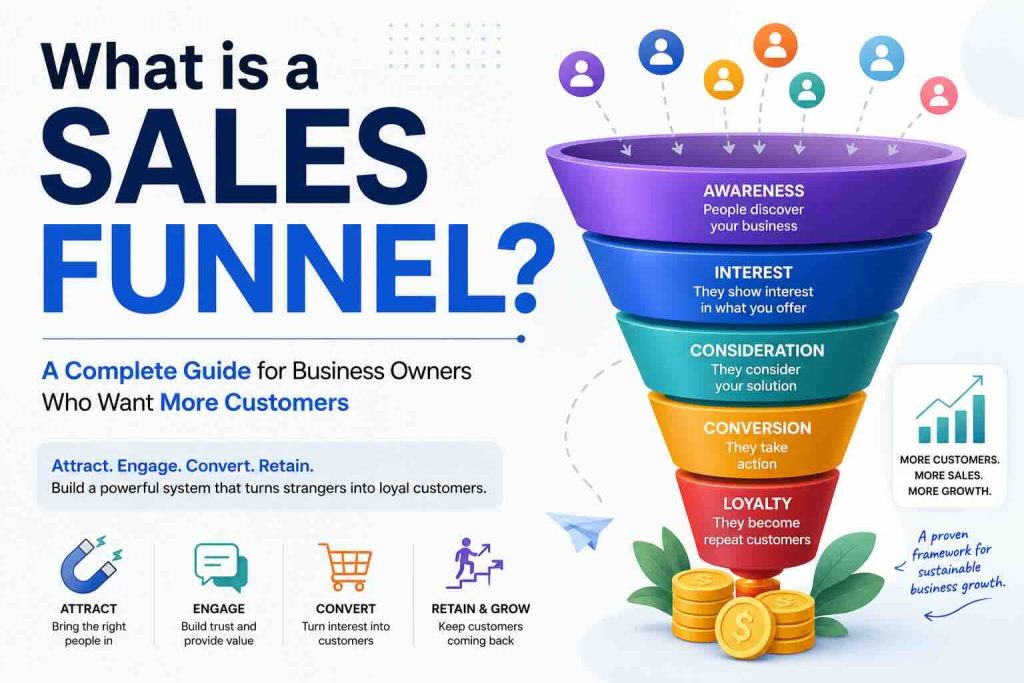
What is a Sales Funnel? A Complete Guide for Business Owners Who Want More Customers
You’ve probably heard the term “sales funnel” thrown around in marketing conversations. But what does it actually mean for your business — and more importantly, why does understanding it change everything about how you attract and convert customers?
What We Cover
- What a sales funnel really is
- Why every business already has one — whether they know it or not
- The four stages of a sales funnel — explained deeply
- A real-world Indian business example
- Common sales funnel mistakes that leak customers
- Sales funnel vs. marketing funnel — is there a difference?
- How to build a sales funnel that actually works
Let’s start with something that happened to one of our clients — a homegrown skincare brand based in Delhi. They were getting decent traffic to their Instagram page. People were commenting, saving their posts, even clicking the link in their bio. But sales? Almost nothing. They couldn’t figure out why.
When we looked at their marketing through the lens of a sales funnel, the problem became obvious immediately. There was a massive gap between “interested” and “purchased” — and nobody had built a bridge across it. No nurturing, no trust-building, no gentle guidance from curiosity to confidence to checkout. People were falling through the cracks at every step.
Once we fixed the funnel? Conversions went up 4x in three months. Same product. Same price. Different journey.
That’s the power of understanding your sales funnel. So let’s break it down — from scratch, without the jargon.
96%
of website visitors are not ready to buy on their first visit
6–8x
more expensive to acquire a new customer than retain an existing one
79%
of marketing leads never convert due to a lack of lead nurturing
50%
more sales-ready leads generated by businesses with strong nurturing funnels
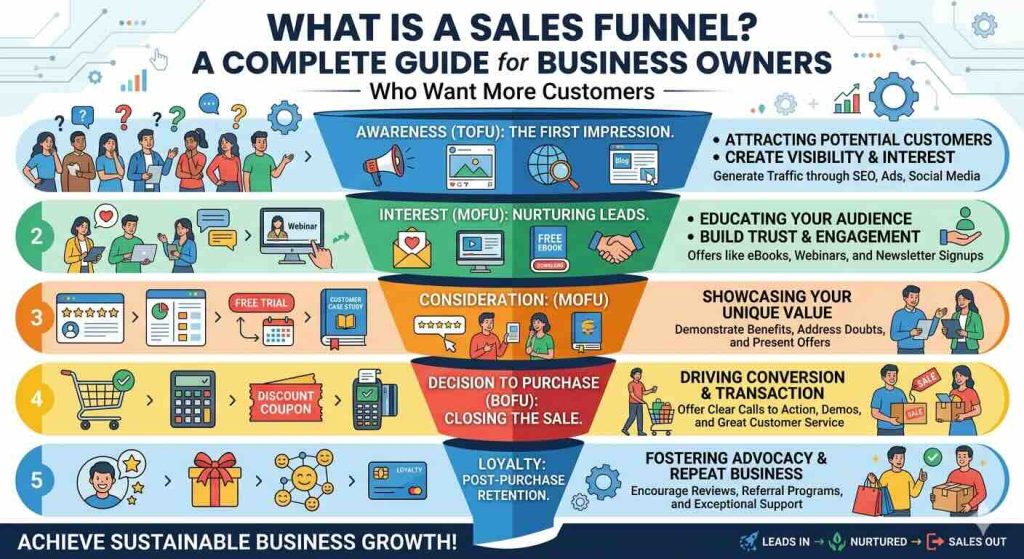
What Is a Sales Funnel — Really?
A sales funnel is the complete journey a potential customer takes from the moment they first hear about your business to the moment they buy from you — and ideally, keep buying from you.
The word “funnel” is a visual metaphor. Imagine a kitchen funnel — wide at the top, narrow at the bottom. At the top, you have a large number of people who’ve heard about you or discovered your brand. As they move through stages of awareness, interest, evaluation, and decision, some drop off at each stage. By the time you reach the bottom, you’re left with the people who actually became customers.
Here’s the visual:
Top of Funnel (TOFU)– Awareness
Strangers discover your brand
▼
Middle of Funnel (MOFU)– Interest & Consideration
They research, compare, and evaluate
▼
Bottom of Funnel (BOFU)– Decision & Purchase
They decide and buy
▼
Beyond the Funnel– Loyalty & Advocacy
They return and recommend you
Simple enough, right? But here’s where most businesses miss the point. They treat a sale as the destination — the finish line. The best businesses treat a sale as the beginning of a relationship. The funnel never really ends; it loops back into itself, turning customers into repeat buyers and advocates who bring in new people at the top.
“A sales funnel isn’t a machine that produces transactions. It’s a system that builds relationships — one thoughtful touchpoint at a time.”
Why Every Business Already Has a Funnel — Whether They Know It or Not
Here’s a truth that surprises most business owners: you already have a sales funnel. It’s just that for most businesses, it’s unintentional, full of holes, and nobody’s managing it.
Every time someone hears your name through word-of-mouth — that’s the top of your funnel. Whenever they visit your website or check your Instagram — that’s the middle. Each time they send you a WhatsApp message or walk into your shop — that’s the bottom. And every time a happy customer tells a friend — that’s the loyalty loop.
The difference between businesses that grow predictably and those that rely on luck is this: the growing ones have intentionally designed each stage of that journey. They know who enters the funnel, what happens at each stage, where people drop off, and how to fix it. The others are hoping things work out.
Understanding your funnel means you stop leaving growth to chance.
The Four Stages of a Sales Funnel — Explained Deeply
Let’s go through each stage in detail — what’s happening in the customer’s mind, what your job is at that moment, and what content or tactics actually work.
🌐 Stage 1 — Top of Funnel
Awareness — “I’ve just discovered you exist”
This is the widest part of the funnel — and the noisiest. The person at this stage doesn’t know you yet. They might have stumbled upon your Instagram Reel, found your blog on Google, seen a friend share your post, or heard about you from a neighbour. They haven’t decided they need you. They’re just… noticing you.
At this stage, your only job is to make a good first impression and give them a reason to pay attention. You’re not trying to sell anything yet. You’re trying to be interesting, useful, or relatable enough that they don’t immediately scroll past.
What’s going through their mind: “Oh, this looks interesting. What’s this about?”
📱 Social media posts & Reels📝 Blog articles (SEO)🎥 YouTube videos📢 Paid awareness ads🎙️ Podcasts & PR👥 Influencer content
✦ What Works at This Stage
Content that educates, entertains, or solves a small problem for free. Don’t lead with “Buy now.” Lead with value. A skincare brand posting “5 reasons your moisturiser isn’t working” will attract far more awareness than a product advertisement.
🤔 Stage 2 — Middle of Funnel
Interest & Consideration — “I’m intrigued. Tell me more.”
This is the make-or-break stage — and the one where most businesses lose the most customers. The person is now genuinely interested. They’ve followed your page, subscribed to your emails, bookmarked your website, or started comparing you to competitors. They’re doing their homework.
What they’re really doing at this stage is answering one question: Can I trust this brand enough to give them my money? They’re looking for evidence. Reviews, testimonials, detailed information, transparency, expertise. They want to be educated, not sold to. They want to feel like they’re making an informed decision — not being persuaded into one.
This is where most businesses rush. They see interest and immediately try to close the sale. But push too hard here, and you lose them. The middle of the funnel requires patience and genuine helpfulness.
What’s going through their mind: “This seems good, but let me make sure before I commit.”
📧 Email nurture sequences📖 In-depth guides & case studies⭐ Reviews & testimonials🆓 Free samples / trials🎬 Product demo videos❓ FAQ content🔄 Retargeting ads
✦ What Works at This Stage
Answer every objection before it becomes a reason to leave. If people always ask “Is this worth the price?” — create content that answers that directly. If they worry about quality — show real before/after results, real customer stories, real evidence. Remove doubt, don’t avoid it.
💳 Stage 3 — Bottom of Funnel
Decision & Purchase — “Okay. I’m ready. Let me buy.”
The person has done their research. They’ve decided they want what you’re offering. They might even have decided they want it from you specifically. All that’s left is the final nudge and a frictionless path to completing the purchase.
At this stage, your job is simple in theory but critical in practice: get out of your own way. Nothing should make this purchase harder than it needs to be. Nor a complicated checkout process. Neither hidden shipping charges appearing at the last second. Not a website that crashes on mobile. And certainly ot a form with fifteen fields when three would do.
This is also where a little psychology goes a long way. A gentle sense of urgency (“Only 4 left”), a risk-reducing guarantee (“30-day money back”), and strong social proof right at the point of decision (“4.9 stars from 840 customers”) can dramatically increase the percentage of people who follow through.
What’s going through their mind: “I’ve decided. Just make this easy.”
🏷️ Limited-time offers🛡️ Money-back guarantees💬 Live chat support📲 Simple checkout flow⭐ Last-moment social proof🎯 Conversion-focused landing pages
✦ What Works at This Stage
Test your own checkout process right now as if you were a new customer. Count every click, every form field, every potential point of confusion. Every unnecessary step is a customer you’re losing. Reduce friction ruthlessly — and make sure your website works perfectly on mobile, because that’s where most Indian buyers complete their purchases.
❤️ Stage 4 — Beyond the Funnel
Loyalty & Advocacy — “I love this brand. You should try it.”
This is the stage that most marketing textbooks mention briefly and then move on from — but honestly, it’s the most valuable stage of the entire funnel. A loyal customer doesn’t just buy again. They tell their friends, write reviews, defend your brand in conversations, and become a free marketing channel you didn’t have to pay for.
The best part? Acquiring a new customer costs six to eight times more than retaining an existing one. Which means every rupee you invest in making your current customers happy is significantly more efficient than spending the same amount on attracting new ones.
In India’s relationship-driven culture, this stage is especially powerful. A satisfied customer in a family-oriented, community-linked society doesn’t just tell one friend. They tell their whole family, their WhatsApp group, their colony. Word-of-mouth in India has a multiplier effect that most brands underestimate.
What’s going through their mind: “That was genuinely great. I’m coming back — and I’m telling people.”
🎁 Loyalty programmes💌 Post-purchase email care🔄 Re-engagement campaigns📣 Referral incentives🌟 Review requests🎂 Personalised offers
✦ What Works at This Stage
Send a genuine thank-you after every purchase. Follow up to check if they’re happy. Ask for a review — most satisfied customers are willing; they just need to be asked. Create a simple referral incentive. A customer who feels remembered and valued doesn’t need a reason to go elsewhere.
A Real-World Example — A Sales Funnel for an Indian Business
Let’s make this concrete. Here’s what a sales funnel looks like for a small coaching institute in a tier-2 Indian city:
📚 Example: Online Coaching Institute — Jaipur
1 Awareness (TOFU): A student in Jaipur searches “how to prepare for CA Foundation 2026” on Google. They find a helpful blog article published by the institute. They also see a useful YouTube Short explaining a tricky accounting concept, leading to following the institute’s page.
2 Consideration (MOFU):The institute sends a free PDF study planner to everyone who fills out a “Download Free Guide” form. Over the next two weeks, the student receives three helpful emails — study tips, a student success story, and a free practice test. They also watch two demo class videos on YouTube.
3 Decision (BOFU): A retargeting ad on Instagram reminds the student about the upcoming batch. The ad shows a “Enroll before Sunday and get ₹500 off + free mock test series” offer. The landing page has 40+ Google reviews, a simple enrollment form, and UPI/card payment. The student enrolls in 4 minutes.
4 Loyalty: After the course, the institute sends a personalised result congratulation message. They ask for a Google review and offer a ₹300 referral discount for the student’s next batch. The student refers two friends from their school WhatsApp group.
Notice that at no stage did the institute desperately push a sale. They led with value, built trust gradually, made the purchase easy, and invested in the relationship after the sale. That’s a well-designed funnel in action.
Common Sales Funnel Mistakes That Leak Customers
Now that you understand how a funnel should work, let’s talk about the gaps that silently drain customers out of it — because most businesses have at least three of these.
No awareness strategy: If no new people are discovering your brand consistently, the top of your funnel runs dry. You can’t convert people who never found you in the first place. Content marketing, SEO, and social presence are not optional — they’re how you fill the funnel from the top.
Jumping straight to the sale: Meeting someone for the first time and immediately asking them to buy is the digital equivalent of a first date marriage proposal. Nurture the relationship. Educate. Build trust. Then sell.
No follow-up system: Most leads go cold not because they lost interest — but because nobody followed up. A person who showed interest last month and heard nothing from you is a wasted opportunity. Automated email sequences, retargeting ads, and WhatsApp follow-ups exist precisely to solve this.
A leaky checkout: A complicated, slow, or untrustworthy checkout process is a conversion killer. People decided to buy — and then changed their mind because the process was too hard. Every extra click between “I want this” and “order placed” loses customers.
Ignoring existing customers: Treating every sale as the end of the journey means you’re constantly fighting to replace customers instead of building on them. The most efficient businesses grow their revenue primarily from existing customer relationships — upsells, repeat purchases, referrals.
Building the funnel and forgetting it: A funnel is not a “set it and forget it” system. Customer behaviour changes. Platforms change. Offers go stale. The best funnels are regularly reviewed, tested, and improved based on real data — where are people dropping off? What’s the conversion rate at each stage? What needs to change?
Sales Funnel vs. Marketing Funnel — Is There a Difference?
You’ll often hear both terms used interchangeably — but they’re slightly different, and knowing the difference helps you think more clearly about your strategy.
| Aspect | Marketing Funnel | Sales Funnel |
| Focus | Generating awareness & interest in your brand | Converting interested prospects into paying customers |
| Stages covered | Primarily Top and Middle of Funnel | Primarily Middle and Bottom of Funnel |
| Primary tools | Content, SEO, social media, ads, PR | Landing pages, email sequences, offers, CRM, follow-up |
| Goal | Attract and educate qualified leads | Convert leads into customers efficiently |
| Who owns it | Marketing team | Sales team (or combined in smaller businesses) |
In practice — especially for small and mid-sized Indian businesses where marketing and sales are handled by the same people — the distinction matters less than understanding that both halves need to work together. A brilliant marketing funnel that generates leads means nothing if the sales funnel drops them. A great sales process can’t save you if the marketing funnel sends you the wrong people to begin with.
How to Build a Sales Funnel That Actually Works for Your Business
Ready to take action? Here’s a clear, step-by-step starting point:
Your Sales Funnel Action Plan
- ◆Map your current journey: Write down every touchpoint a customer has with your business — from first discovery to post-purchase. Where does it start? Where does it end? Where are the gaps?
- ◆Fix the top first: If new people aren’t finding you consistently, work on your SEO, social presence, or paid awareness ads. An empty funnel top means everything downstream starves.
- ◆Build a nurture sequence: Create at least 3–5 emails or messages that educate and build trust after someone shows initial interest. Automate it so it happens without you.
- ◆Audit your conversion point: Test your own checkout, enquiry form, or booking process as a stranger would. Remove every unnecessary step, every source of confusion, every hidden surprise.
- ◆Add social proof everywhere: Reviews, testimonials, case studies, customer photos — place them at the consideration and decision stages where trust is most critical.
- ◆Create a post-purchase plan: What happens after someone buys? Design a simple loyalty loop — a thank you, a follow-up, a review request, and a reason to come back.
- ◆Measure and improve monthly: Track conversion rates at each stage. Where are people dropping off most? That’s your priority to fix next month.
Final Thoughts — Your Funnel Is Your Growth Engine
Here’s the most important thing to take away from everything we’ve covered: a sales funnel is not a complicated technology or a secret only big companies have access to. It’s simply a clear, intentional answer to one question — how do strangers become customers, and how do customers become loyal advocates?
When you don’t have a funnel, you’re relying on chance. Some people will find you, like you, and buy from you — but you don’t know why, you can’t replicate it, and you can’t improve it. When you do have a funnel — even a simple one — you have a system. You have levers you can pull and see where people fall off. Therefore you can fix it. You can predict, plan, and grow.
We’ve helped businesses across categories — education, retail, services, D2C, B2B — build and optimise their sales funnels. And what we’ve found, consistently, is that even small improvements at each stage of the funnel compound into dramatic results. Fixing the awareness stage fills the pipeline. Modifying the nurture stage warms up more leads. Adjusting the checkout increases conversions. Fixing the loyalty stage reduces churn and generates referrals. The results multiply on each other.
You don’t need to fix everything at once. Start with the stage that’s leaking the most — and go from there.
“The businesses that grow consistently aren’t luckier. They’ve simply built a clearer path from ‘stranger’ to ‘loyal customer’ — and they keep making that path better.”
Want to map out your sales funnel and find where you’re losing customers?
The Digi Modway team offers a free funnel audit — let’s find the gaps and fix them together.
~ Digi Modway Editorial Team
Helping Indian businesses build smarter systems, stronger funnels, and sustainable growth.